Product

One console for the whole network.

Every station and unit with its condition, ranked worst first. Roll-ups show the worst case, never an average, so one failing rectifier cannot hide among healthy ones.
01 / Fleet

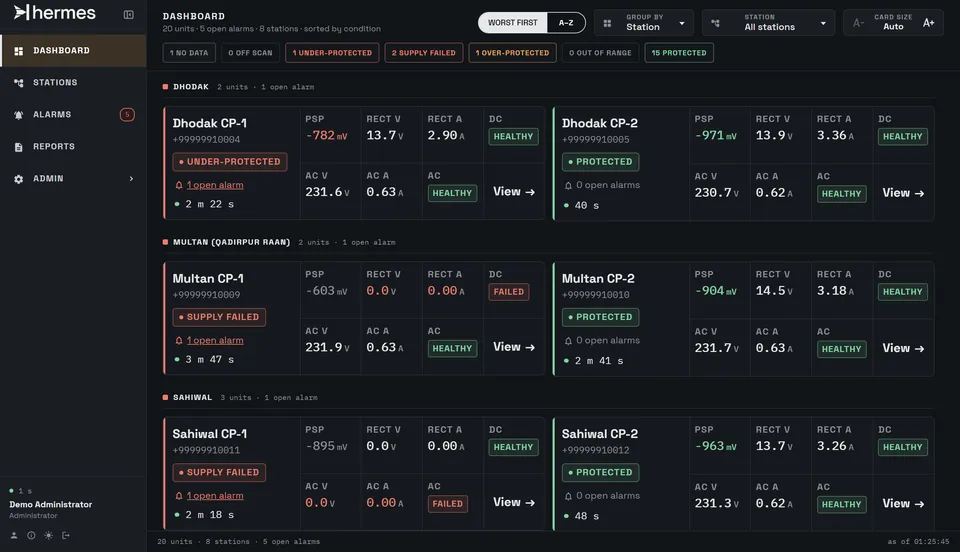
The whole network on one screen.

  • One clear condition per unit.

    Protected, under-protected, over-protected, out of range, supply failed, no data or off scan, each with its reason in plain words.

  • No false reassurance.

    A silent unit shows no data, its last values are labelled last known, and a value that was not measured shows "—", never zero.

  • Link and system health.

    Receivers, ingest, edge agents and backups, each with its own alarm.

  • Stations and units.

    Station by station, with exception chips and search. Unassigned units are never lost.

Fleet dashboard, every unit ranked worst first
Screenshot of the live demo, simulated data.

02 / Unit

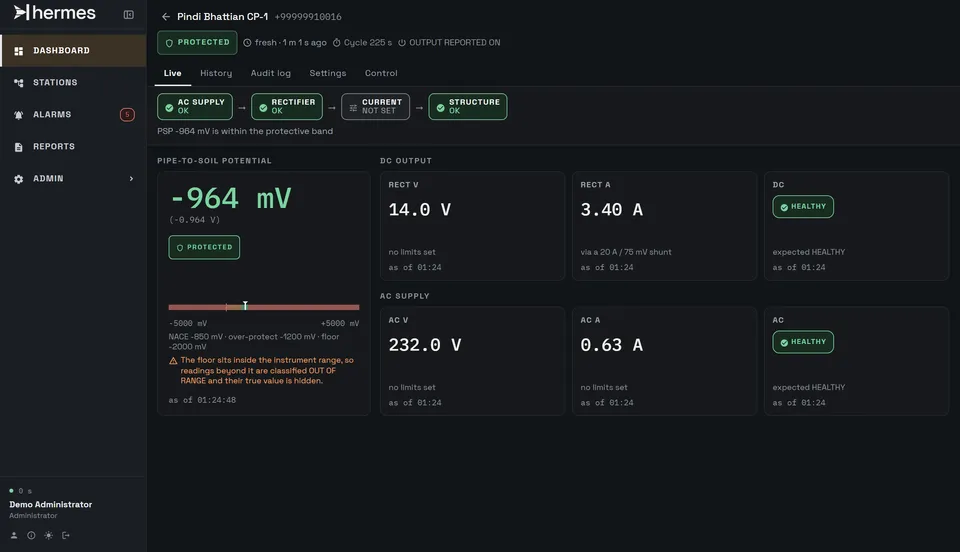
Every unit, one workbench.

  • Live.

    Current values with their age, a protection-band ruler against −850 mV, and a chain strip that shows the first broken link from AC supply to structure.

  • History.

    Charts over the whole retention period, an average line with a min-max envelope, and gaps shown honestly, never filled in.

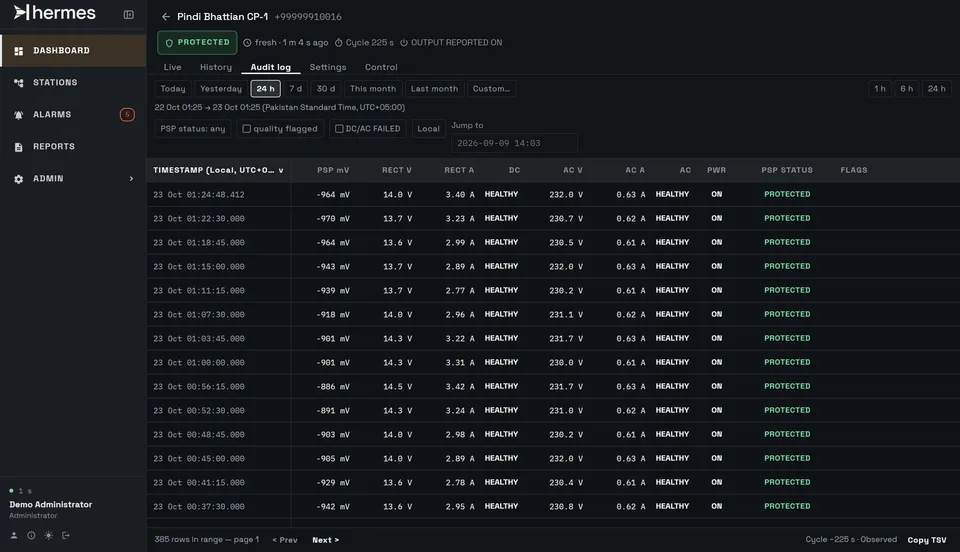
  • Audit log.

    Every stored reading with its protection status as recorded at the time, never rewritten.

  • Settings.

    Identity, shunt rating, protection thresholds, alarm limits and notification choices.

  • Diagram.

    A live process diagram of the unit, bound to real readings.

One unit with its live channels
Screenshot of the live demo, simulated data.
The audit log of one unit, every reading with its protection status
Screenshot of the live demo, simulated data.

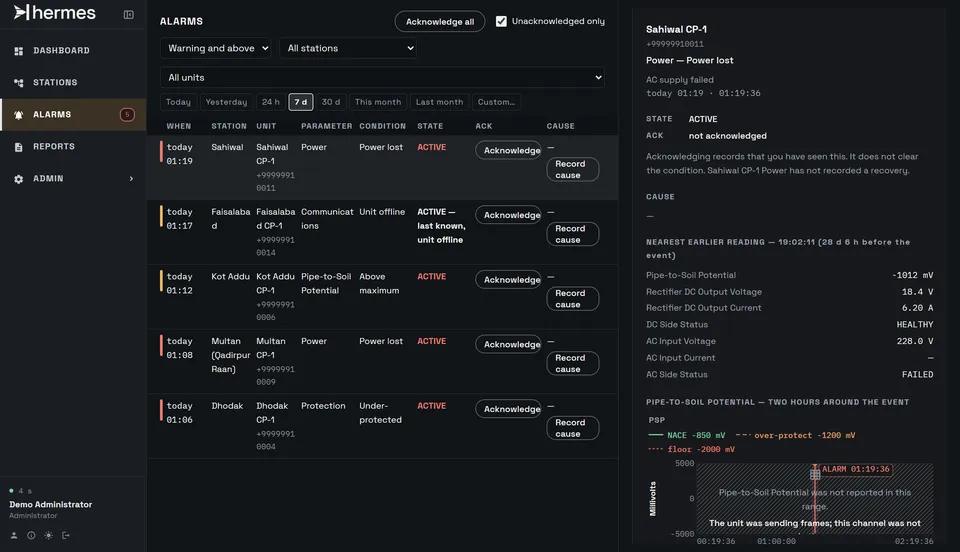
03 / Alarms

Alarms that run whether anyone is signed in or not.

  • Safety alarms stay on.

    Protection and supply-failure alarms cannot be switched off.

  • No nuisance alarms.

    A reading hovering at a limit raises one alarm and clears once.

  • Acknowledged, never hidden.

    The first acknowledgement is kept with name and time, and acknowledging never hides a live fault.

  • Fault-cause history.

    Technicians record what each alarm turned out to be, from reference cell to rectifier to ground bed.

  • Every channel you use.

    Email, mobile and browser push, desktop notifications that also work offline, and SMS through your own SIM.

The alarm list with acknowledge and record cause
Screenshot of the live demo, simulated data.

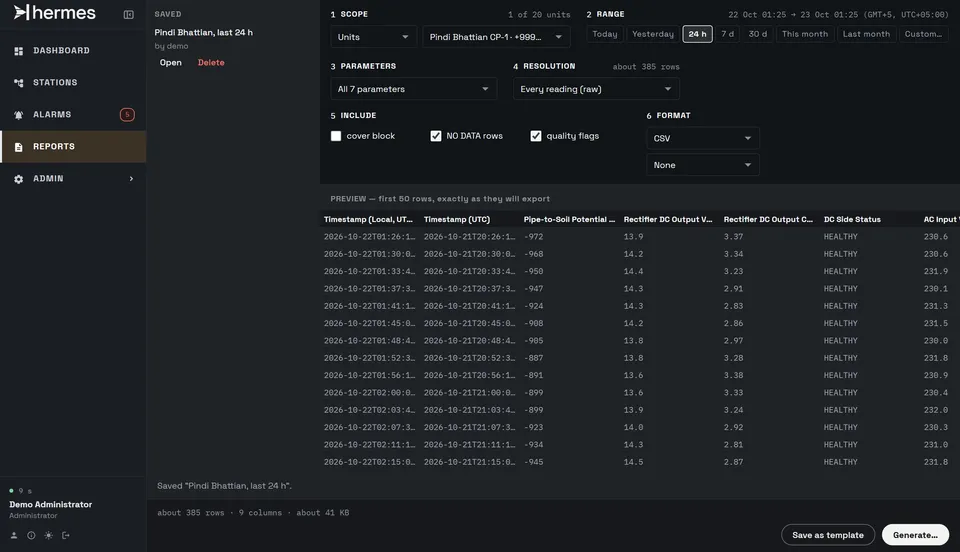
04 / Reports

Reports your auditors can rely on.

  • Readings, alarms, commands and changes.

    Raw, hourly or daily, for a unit, a station or the whole site.

  • Time-zone safe.

    Every time in local time with its offset, and in UTC.

  • Excel, CSV and JSON Lines.

    Plus chart images.

  • Tamper-evident exports.

    Password-protected, so auditors can see the record has not been altered.

  • Saved templates.

    Relative ranges such as last month recalculate on their own.

The report builder set to a CSV export
Screenshot of the live demo, simulated data.

05 / Roles and audit

Give each person only what their job needs.

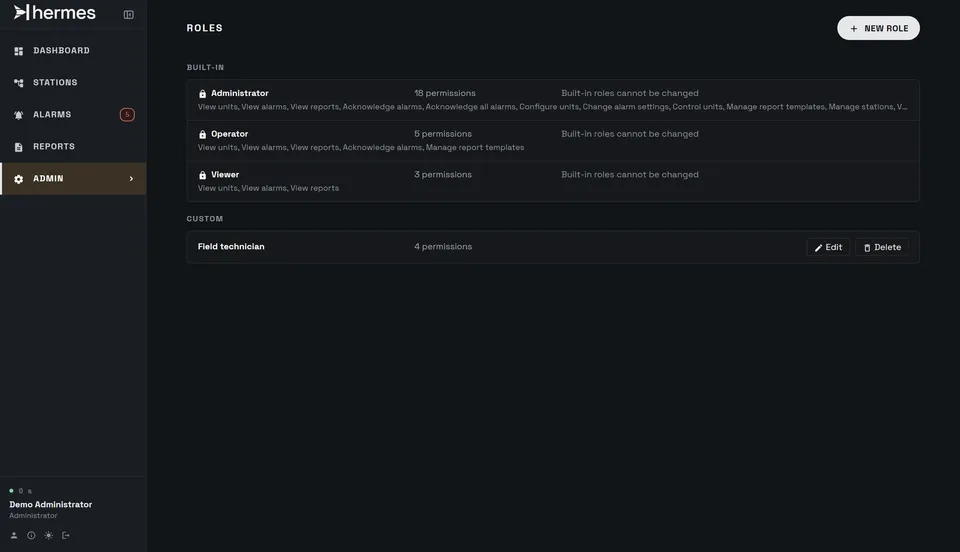
  • Built-in and custom roles.

    Administrator, Operator and Viewer are protected. Add your own, such as Survey Technician or Integrity Engineer.

  • Station scope.

    Limit any user or API key to specific stations.

  • Account security.

    Lockout after failed attempts, idle sign-out, session revocation and self-service password reset.

  • Append-only audit log.

    Sign-ins, setting changes, acknowledgements, fault causes and commands, with who, what and when.

  • Configuration history.

    Every change to an alarm limit, PSP threshold or shunt record is kept with the value it replaced, so you can show which limits were in force on any past date.

Built-in and custom roles
Screenshot of the live demo, simulated data.

06 / Data

Your data, kept and recoverable.

  • Retention.

    One year of full-resolution readings on Hermes Cloud, with 2 or 3 years as an add-on. On your own infrastructure, you decide.

  • Backups.

    Scheduled, encrypted and verified, with point-in-time recovery on Hermes Cloud.

  • Safe restore.

    Restores into a fresh database before swapping it in, and cancels unsettled commands, so nothing stale reaches the field.

07 / Integrations

Integrate without a project.

  • One versioned API.

    A breaking change needs a new API version, so integrations never break silently.

  • Scoped keys.

    Revocable API keys, limited by permission, station and expiry.

  • Signed webhooks.

    Signed and replay-protected.

  • Bulk export.

    Paged, and filterable by status and quality flags.

08 / Equipment

One platform for every power asset on the network.

What Hermes reads, and which commands a unit accepts, come from its model profile. Adding a model is configuration, not a software release.

  1. 01

    Cathodic protection

    Monitor and control.

    Through Argus and Cyclops, or Modbus TCP/RTU direct.

    Typical parameters
    • Pipe-to-Soil Potential (PSP)
    • Rectifier DC Output Voltage
    • Rectifier DC Output Current
    • AC Input Voltage
    • DC Side Status
    • AC Side Status
    • AC Input Current

    Seven or more, depending on the CP configuration: a TEG unit, solar or a GPS interrupter brings its own parameters.

    Configurations vary. We can provide any parameter you need.

  2. 02

    DC power supplies and rectifiers

    Monitor and control.

    Through Argus and Cyclops, or Modbus TCP/RTU direct.

    Typical parameters
    • DC V
    • DC A
    • AC V
    • AC A
    • DC Fuse Status
    • AC Fuse Status
    • Power Analyzer

    Configurations vary. We can provide any parameter you need.

  3. 03

    Battery chargers and DC systems

    Monitor and control.

    Through Argus and Cyclops, or Modbus TCP/RTU direct.

    Typical parameters
    • AC V
    • AC A
    • DC Aux. V
    • DC Batt. V
    • DC Aux. Load Current
    • DC Charging-Discharging Current
    • Alarms and Indications

    Configurations vary. We can provide any parameter you need.

  4. 04

    Defence and aviation ground support

    Monitor and control.

    Through Argus and Cyclops, or Modbus TCP/RTU direct.

    Typical parameters
    • DC V
    • DC A
    • Input AC V
    • Input AC A
    • Output AC V
    • Output AC A
    • Input Frequency
    • Output Frequency
    • Uptime

    Configurations vary. We can provide any parameter you need.

  5. 05

    Voltage regulation and power conditioning

    Monitor and control.

    Through Argus and Cyclops, or Modbus TCP/RTU direct.

    Typical parameters
    • Output Current — Phase A/B/C
    • Input Voltage — Phase A/B/C
    • Output Voltage — Phase A/B/C
    • Input Current — Phase A/B/C
    • Ambient Temperature
    • Over-Voltage Fault
    • Under-Voltage Fault
    • Over-Current Fault
    • Over-Temperature Fault
    • EEPROM Fault
    • Output Enabled
    • Regulating

    Configurations vary. We can provide any parameter you need.

  6. 06

    Control electronics and modules

    Monitor and control.

    Through Argus and Cyclops, or Modbus TCP/RTU direct.

    Typical parameters

    Parameters are provided as per your device and its configuration.

    Configurations vary. We can provide any parameter you need.

  7. 07

    Any Modbus TCP/RTU device

    Monitor and control.

    Through Argus and Cyclops, or Modbus TCP/RTU direct.

    Typical parameters

    Parameters are provided as per your device and its configuration.

    Configurations vary. We can provide any parameter you need.

Works with Diode Labs units and any Modbus TCP/RTU device.

Any Modbus device: define or import its register map at commissioning. Hermes rejects overlapping and unsafe writable entries.

09 / Analytics

Analytics that advise, never act.

Advisory only. Computed from each unit's own history, they never change protection status or alarms, and never send a command. If the data is not enough, Hermes says so.

  • Ground-bed remaining life.Add-on

    Tracks the ground-bed resistance trend and estimates when the rectifier will no longer drive enough current, with an uncertainty range.

  • Fault triage.Add-on

    Ranks the likely causes of each abnormal unit with the evidence for each, and gives a "what to bring" list.

  • Rectifier efficiency and ageing.Add-on

    Trends AC in against DC out and flags units that are degrading.

  • Protection-loss early warning.Add-on

    Forecasts PSP 30 days ahead and warns 7–30 days before a unit is expected to cross −850 mV.

  • Over-protection and energy advisor.Add-on

    Finds units driven harder than needed, and always recommends an instant-off survey before you reduce output.

Add-on Add-on, priced on request.

See it running before you talk to anyone.